


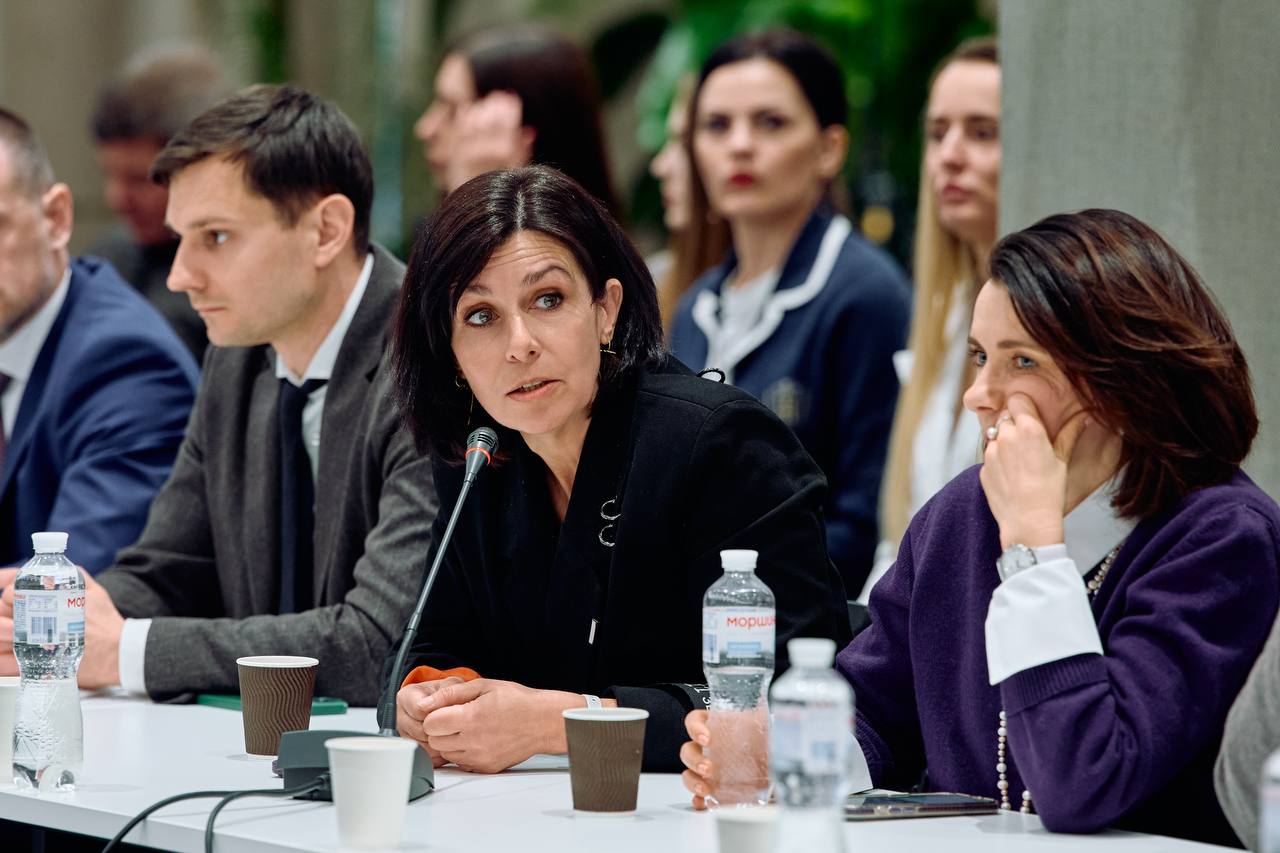
Conference: “Cooperation Between the Reformed State Bureau of Economic Security and Ethical Businesses — First Half of the Year”
On February 27, 2026, a conference titled “Cooperation Between the Revamped Economic Security Bureau and Ethical Businesses—First Six Months” was held in Kyiv—the first large-scale event summarizing the first six months of work by the revamped Economic Security Bureau. The event brought together nearly 100 participants: the Business Ombudsman of Ukraine, heads of leading business associations, bar associations, international chambers of commerce, and company executives.
In an open dialogue format, the EBS leadership presented concrete results of six months of work on de-shadowing key markets, while business associations shared their own assessment of these changes and systemic proposals. The conference demonstrated a qualitative shift in the model of interaction between law enforcement and business: from pressure and suspicion to analytical partnership and a joint search for solutions.
Oleksandr Tsivinsky, Director of the Economic Security Bureau of Ukraine, delivered a keynote address outlining the philosophy and strategy of the reformed Economic Security Bureau: the top priority is not the number of criminal cases, but the de-shadowing of the economy and increasing revenues to the state budget. He openly acknowledged institutional problems: the salaries of EBS detectives are 2.5 times lower than those in other law enforcement agencies. This is primarily due to a discriminatory provision—the basic non-taxable minimum for the EBS is set at 2,102 UAH, instead of 3,028 UAH for other agencies.

The Bureau is only 28% staffed: with an estimated need for 4,000 employees, only 1,145 are currently working, and since August 2025, approximately 150 more people have resigned. Mr. Tsivinsky named three legislative changes that the Bureau needs most:
- aligning the salary calculation base with other law enforcement agencies
- strengthening criminal liability in the area of excise taxes to the level of a “serious crime” with confiscation of property
- granting the BEB the ability to purchase equipment for covert investigative operations.
Separately, he discussed a new concept of mediation—the possibility of resolving a criminal dispute without prosecution, provided that damages to the budget are voluntarily compensated.
Pavlo Buzdygan, Deputy Director of the Economic Security Bureau of Ukraine, presented specific results of the Bureau’s work in key sectors—the fuel market, the electronics market, alcoholic beverages, tobacco products, and the gambling industry.
Since November 2025, the Bureau has identified 538 illegal gas stations across Ukraine. In particular, 421 were uncovered with the help of business associations. The highest concentration of “shadow” gas stations is in the Odesa and Lviv regions. Thanks to comprehensive efforts—including dismantling, shutting down operations, and seizing fuel tankers—budget revenues for October–December 2025 increased by 2.3 billion UAH compared to the previous year.
In the electronics sector: following a series of meetings with market players and clarification of the requirements, some companies voluntarily came out of the shadows—the number of fiscal receipts rose from 6.6 million in September to 8.2 million in December (+23%). Mr. Buzdygan emphasized that the guiding principle is not sporadic enforcement but a systematic, sector-wide approach across all areas within the limits of available resources.
He also spoke about cleansing the alcohol market of illegal products. Specifically, in 2025, the BEB seized seven times more products than in 2024 (2025: 303.8 million UAH; 2024: 43.5 million UAH). Against the backdrop of the BEB’s systematic fight against illegal production, smuggling, and counterfeiting, legal revenue increased by 15.9% (+23.6 billion UAH).
In addition, as Pavlo Buzdygan noted, thanks to changes in the BEB’s approach to cracking down on illegal gambling establishments, it was possible to prevent their rapid resumption of operations after equipment was seized. The BEB initiates the seizure of premises where illegal gambling is organized and conducts preventive measures with the owners. In 2025, 25 premises were seized, 507 searches were conducted, 6,000 pieces of equipment were seized, 70 suspects were identified, and 24 cases were referred to court.
Yaroslav Starovoitenko, president of the Ukrainian Oil and Gas Association, confirmed on behalf of the industry that the results of the BEB’s work in the fuel market are tangible. He noted that just a year ago, the association had high hopes for the revamped BEB, and those hopes are now being realized.

The key difference compared to previous approaches is that the Bureau has, for the first time, independently expanded the list of violations by adding another 20–30% of facilities—which it identified on its own—to the association’s list of illegal gas stations. Mr. Starovoitenko also noted a qualitative change in the behavior of shadow market players: some are dismantling their facilities on their own, realizing that the Bureau is determined to act—even before direct intervention by law enforcement. However, this is only the beginning, and there is still a lot of work ahead. The fight against the illegal segment requires constant attention from the state; law enforcement agencies must keep this issue in focus at all times. The shadow in Ukraine’s fuel market is multifaceted: it includes retail outlets operating without licenses, tax fraud, and the illegal production of fuel. He emphasized that effective de-shadowing is possible only through a bilateral partnership: the industry sees the problems from the inside, while the BEB has the tools to respond.
Yuriy Peroganych, CEO of the Association of Information Technology Enterprises of Ukraine, also confirmed the positive dynamics in the electronics market. Some legal players are showing up to 50% growth in official sales—and this is a direct result of the joint work between the BEB and the State Tax Service. At the same time, he emphasized that the shadow market segment remains significant and the process of de-shadowing needs to be accelerated.

Mr. Peroganych called for a practical step—the creation of a registry of legal phones (based on IMEI codes) as the first, relatively simple component of a tracking system. The BEB supported this idea without introducing a mechanism to disable illegal devices. A representative of the association confirmed its readiness to actively support legislative initiatives publicly—in particular, by shaping public opinion in the media.
Serhiy Badriddinov, CEO of Intertop and Chair of the EBA Retail Trade Committee, praised the results in the fuel sector and the electronics market, but immediately posed a fundamental question: when will similar systematic work begin across the entire retail sector?
He cited a specific example: one large supermarket chain (approximately 500 stores) is structured through more than 1,500 sole proprietorships, which is an obvious fragmentation scheme. The chair of the Verkhovna Rada’s Budget Committee writes openly about it, everyone knows about it—but there is no reaction.
Mr. Badriddinov also raised the issue of customs: unequal conditions during customs clearance. This makes fair competition impossible. He called on the BEB to conduct a comprehensive audit of the supply chain from the border to the end consumer—especially in the fashion and grocery retail sectors.
Anka Feldhusen, Ukraine’s Business Ombudsman, explained that the Business Ombudsman Council has joined the initiative to combat the shadow economy in the electronics market as a partner of the BEB and the State Tax Service. A memorandum between the parties has not yet been signed, but concrete results—an increase in legal revenues—are already evident, as shown by BEB statistics. Ms. Feldhusen emphasized that open and sincere communication between regulators and business proved to be the most effective tool, yielding results even before the formal establishment of cooperation. In her view, this is the most valuable lesson for future work.

Andriy Antoniuk, president of the Ukrainian Taxi Association, raised one of the most pressing issues—the illegal car market, the scale of which he compared to the electronics market: “Near every vehicle registration office, there is a company that sells 300 cars a day with an average cost of $20,000”—and yet has zero turnover in its accounts and pays zero taxes.
He noted that the association had sent a letter to the director of the State Bureau of Investigation regarding this matter and called for a joint analysis of the automotive market using a clear methodology. Specifically, to identify the causes of every “loophole” in the legislation and to name each scheme.

Victoria Ptashnik, an attorney, addressed the issue of intellectual property rights protection—and did so by citing specific cases from the BEB’s practice. Detectives on the ground openly say, “There are no sanctions there; what is there to investigate?”—referring to Article 229 (trademark counterfeiting), the third part of which constitutes a serious crime but does not provide for imprisonment. As a result, companies have been illegally manufacturing goods under foreign brands for years. When a case is finally investigated, the material damage to the victim is assessed at a few tens of thousands of hryvnias, while the actual damage amounts to tens of millions.
Ptashnyk proposed two specific actions: to convey to investigators the philosophy of protecting rights holders as a priority and to pay closer attention to cases where Article 229 serves as a predicate offense for money laundering. In response, Mr. Tsivinsky noted three recently received letters of appreciation from Duracell and Apple—and invited the attorney to provide specific information on the identified violations directly to the deputy director.
Grigol Katamadze, president of the Ukrainian Taxpayers Association, emphasized that six months ago he took a break and deliberately refrained from commenting on the BEB’s work—in order to assess its progress. And today he truly sees the results of that work. Mr. Katamadze called on the business community to jointly advocate for a larger budget for the BEB and for salaries to be brought in line with those at NABU and SAPO through joint appeals to the Ministry of Finance.

Rostislav Korobka, Vice President of the Ukrainian Chamber of Commerce and Industry, raised the issue of joint financing institutions (JFIs)—a specific tool that is actively used for tax optimization in the construction and agricultural sectors. He noted that current legislation on JFI effectively legalizes opaque schemes and asked what work is being done in this area and how to organize a substantive sector-specific discussion.
Natalia Fesyun, CEO of the Ukrtytun Association, drew attention to alarming trends in the tobacco market: the level of illicit trade began to rise again in 2025. At the same time, sales of legal products fell by 15%—despite the fact that the tobacco industry accounts for 7% of tax revenues to the state budget. She made a specific request: to open a regional office of the Bureau of Economic Security in the Dnipropetrovsk region, where 25% of illegal products are sold. In monetary terms, this amounts to approximately 7 billion hryvnia in annual budget losses.
Fesyun also called on the Bureau to intensify efforts to combat online trade in illegal products and thanked the detectives for their active work in investigating the activities of large vape shop chains.
Tetyana Koshchuk of the Crawford Institute focused on the still-unresolved challenges of bringing the e-cigarette market into the open—a segment that is growing rapidly but remains 93% illegal. The figures speak for themselves: in 2025, the budget received only up to 0.5 billion UAH in excise tax from e-cigarettes—while 122 billion UAH of this tax was collected from conventional cigarettes and other tobacco products. The share of vape users already accounts for 5% of the adult population (compared to 22% of regular cigarette smokers). Meanwhile, the excise tax rate on regular cigarettes rose by 47% over the past year, accelerating the shift of consumers toward the illegal vape segment. This was one of the factors contributing to the shortfall of UAH 7 billion in the planned excise tax revenue from tobacco products and e-cigarette liquids.
Daria Svistula, chair of the Committee on Business and Property Rights Protection of the Federation of Employers of Ukraine, raised a systemic issue directly affecting members of the associations present. A significant number of criminal cases at the BEB have remained uninvestigated, unresolved, and stagnant for years—detectives are overburdened, and resources are limited.
She described a specific situation: motions filed to dismiss cases due to lack of criminal grounds remain pending for months without any procedural decisions. Svistula asked: Is it possible to establish a formalized mechanism for cooperation between business associations and the Bureau to address such cases? Mr. Tsivinsky confirmed that such a channel already exists, but acknowledged that, given the certification process and the detectives’ heavy workload, the system is failing. He promised that the new team’s priority would be to reduce “dead” cases and transition to an “either court or dismissal” model.
Yosyp Buchynskyi, Vice President of the Ukrainian Taxpayers Association, presented a detailed analysis of criminal proceedings under Article 212 (tax evasion).
Mr. Buchynskyi also supported the BEB’s initiative on pre-trial settlement (mediation)—and separately noted that the reduction in pressure on businesses over the past six months has been real and tangible. Buchynskyi also cited a specific instance of abuse by a particular detective—and noted that a complaint addressed to the director remained unanswered for six months, whereas a similar appeal to the Office of the Prosecutor General received a response on the very third day.
Yefrem Lashchuk, an expert at the Economic Expert Platform, presented proposals from think tanks: a system of nine KPIs for an objective assessment of the BEB’s performance over time (quarter-to-quarter). The proposed framework includes:
- Ratio of registered cases to those referred to court
- Percentage of indictments resulting in a conviction
- Proportion of cases where no charges have been filed after two or more years
- Budget utilization
- Average caseload per detective (number of criminal cases)
- the number of searches conducted without a warrant from an investigating judge
- the number of complaints from businesses (to the Business Ombudsman and leading associations).
He called on the BEB to publish these indicators quarterly in the public domain—in the form of a digest on the website. Tsivinsky agreed with the idea but noted that the Bureau’s analytical effectiveness is also an important indicator that is missing from the proposed system.
Myroslav Laba, an expert at the Economic Expert Platform, presented the results of an analysis of excise goods markets by sector: for fuel, the trend is positive, with the share of the shadow market falling to 14%; in the cigarette market, the share of illegal products rose from 15% to 18% in the fourth quarter; alcohol—the share of the shadow market has fallen and remains at around 12%.
The key point of his speech: in every market, there are a few large companies that “drag it down”—minimizing taxes and paying salaries under the table. If the BEB can force these players to operate “above board,” the entire market will automatically level out: profitability will rise, and so will the tax burden. Mr. Laba urged the Bureau to set clear quantitative goals for de-shadowing each year and to measure progress through comparative indicators.
Yevhen Riako, a representative of the Bar Association, raised two interrelated issues. The first is the near-total absence of judicial precedent under Article 212 in cases where defendants do not admit guilt: the courts hearing such cases simply lack jurisdiction over tax matters, and in 2–3 years this could become a critical issue for the Bureau. He proposed considering the creation of specialized economic courts or specializations within the judicial system.
The second problem is the lack of a right for attorneys to file a motion to change jurisdiction: if a case under the BEB’s jurisdiction ends up with the SBU or another agency, businesses are deprived of a mechanism to “return” it to a more qualified authority. Yevhen provided the number of the relevant bill for the BEB’s support.
Ihor Zhitinsky, chairman of the All-Ukrainian Association of Passenger Carriers, raised the issue of the shadow economy in the bus passenger transport market. He reported that the association had already sent analytical materials to the BEB’s email address and was providing hard copies at the conference. Mr. Zhitinsky reminded the audience of a previous agreement to hold a special industry meeting and asked the Bureau’s leadership to find time for it.
Andriy Yerashov, head of the analytical center of the Union of Ukrainian Entrepreneurs, took a balanced stance: he acknowledged the BEB’s progress but highlighted areas where problems remain. He supported his colleagues’ request to review “outdated” criminal proceedings—especially those opened before the new leadership took office and lacking real grounds. In his view, the Bureau should make the procedure for opening new cases more difficult and instead close those with no prospects.
Mr. Yerashov urged the BEB to communicate more publicly—to showcase not only successes but also systemic changes within the agency: a shift in culture, disciplinary decisions, and changes in investigative approaches.
Oksana Shvets, a representative of the American Chamber of Commerce in Ukraine, confirmed the positive changes in the Bureau’s work over the past six months, as well as the ongoing and productive dialogue between the business community and the Bureau. The Chamber is ready to support all legislative initiatives necessary to provide the Bureau with a full range of tools.
She emphasized that the business community expects to see the results of the BEB’s work in measurable terms—specifically, in Kantar’s research and in direct revenues to the state budget.
Oleksandr Baldyniuk, president of Ukrkondprom, shared a problem specific to his industry: one in every three tons of instant coffee in Ukraine is smuggled, and then counterfeited—packaged under well-known brands with the addition of foreign substances to increase weight. The situation is similar with confectionery products: illegal factories operate in secret, under cover, and remain virtually beyond the reach of regulatory oversight. He requested contact information for a specific industry meeting with the State Bureau of Economic Security (SBES) and received support from the head of the SBES.

Denys Tereshchenko, a member of the Board of the Ukrainian Bar Association, raised two practical questions regarding schemes to fragment businesses through networks of sole proprietorships. First, is there a plan to establish a legal definition of the line between a legitimate franchise and illegal “pseudo-fragmentation”—so that entrepreneurs who have been operating under a certain model for years can understand whether they are in violation of the law? Second, what is the specific procedure for those who wish to legalize their status on their own: how to calculate the amount of unpaid taxes, what is its legal basis, and who is authorized to confirm it?
The Director of the BEB noted that minimizing “splitting” schemes requires both legislative changes and persistent work by the BEB and the State Tax Service. Mr. Tsivinsky presented a concept regarding the BEB’s new approaches to this issue, and positive results are expected in the near future.
The conference marked a qualitative shift in relations between the BEB and the business community: for perhaps the first time in the Bureau’s history, representatives from various sectors noted a real reduction in pressure, successes in de-shadowing a number of industries, and a change in the Bureau’s operational philosophy. Specific figures confirmed the systemic nature of the changes: +2.3 billion UAH in budget revenues from the fuel market over three months, +8.2 billion UAH brought out of the shadows in the electronics market, and positive changes in a number of other sectors.
At the same time, the business community clearly articulated the outstanding issues: critical underfunding of the State Bureau of Investigation, the incomplete formalization of the tobacco and e-cigarette markets, the lack of an effective mechanism for addressing stalled criminal proceedings, and the need for legislative regulation of fragmentation schemes. The parties agreed to hold the next public event in three months and to organize a series of sector-specific meetings: with the automotive market, the confectionery industry, the passenger transport sector, and the ISF.

