


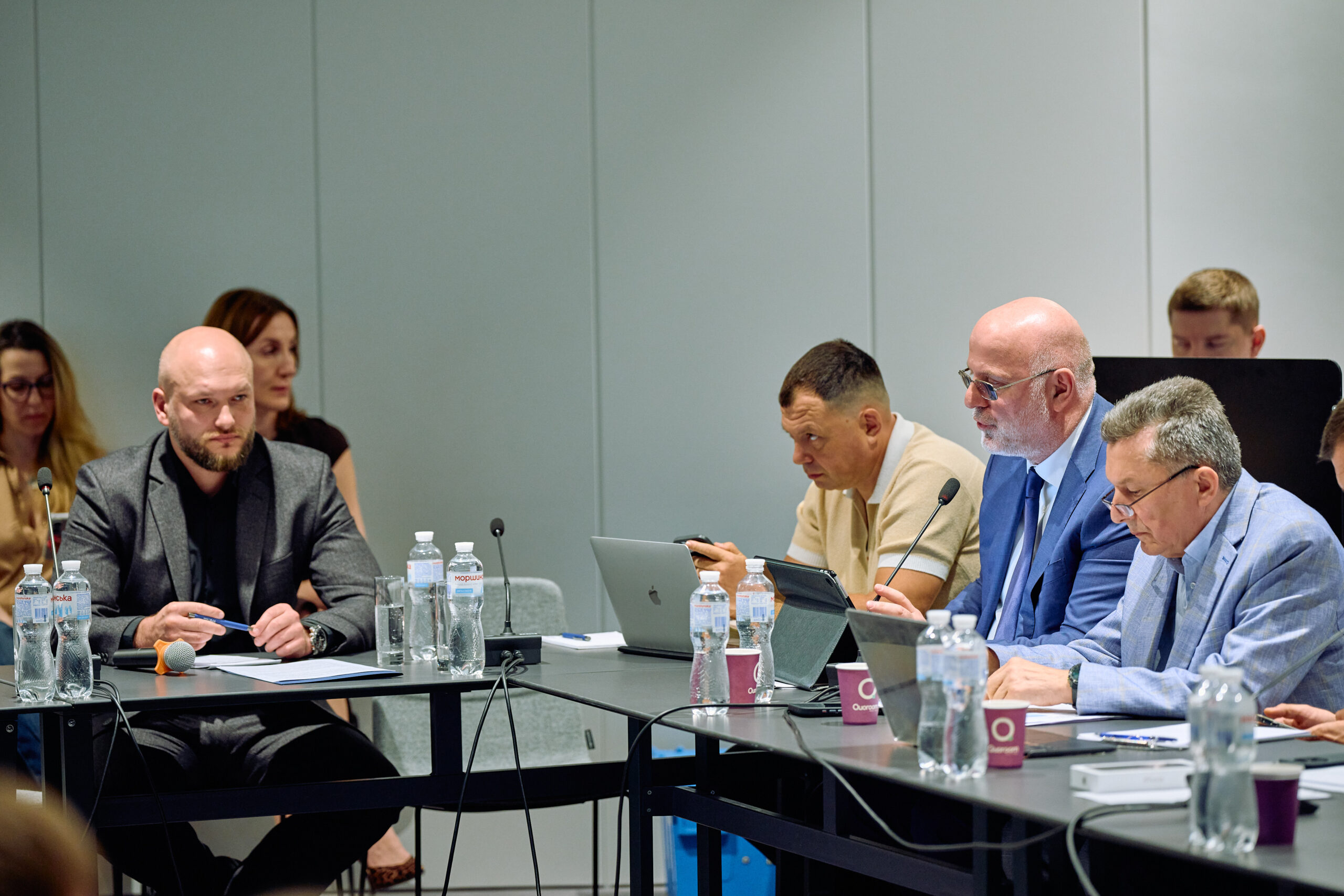
From “presumption of guilt” to partnership: the first meeting of the new BEB leadership with the business community
On August 15, 2025, a conference entitled “Cooperation between the Economic Security Bureau and conscientious businesses – the key to effective counteraction against economic crimes” was held, organized jointly by the Economic Security Bureau and the country’s leading business associations.
The event was attended by more than 50 leaders of leading business associations to discuss cooperation and strategic directions for the development of the Economic Security Bureau of Ukraine under the leadership of its new director, Oleksandr Tsivinsky.
Oleksandr Tsivinsky, director of the Economic Security Bureau of Ukraine, presented his vision for the future of the agency, emphasizing the need for radical changes and the creation of an effective analytical service. He noted that he plans to re-certify all employees of the Bureau as soon as possible with the involvement of international experts, as well as to focus efforts on combating large-scale “gray” schemes.
The director of the BEB also categorically stated zero tolerance for corruption and the need to ensure equal conditions for doing business.

Roman Vashchuk, Business Ombudsman of Ukraine, expressed a critical assessment of the Bureau’s previous work, calling it a repeat version of the tax police with a negative budget. According to him, with a budget of UAH 1.9 billion, the budget revenue amounted to only UAH 846 million.
“I am positive about the future of the BEB, but I am critical of its past,” Vashchuk said, stressing the need to change the paradigm from “presumption of bad faith” to “presumption of good faith of business.”

Grigol Katamadze, president of the Taxpayers Association of Ukraine, presented a detailed analysis of the shadow economy and proposed a system of key performance indicators for the BEB, which are aimed at paying more attention to the “gray” business and reducing problems for white businesses. He noted that huge assets worth more than $100 billion have been taken out of the country and need to be returned. Katamadze publicly offered his help to the new director, sharing his expert ideas on how to reform the agency.

Oksana Shvets, representative of the American Chamber of Commerce, emphasized the importance of focusing the BEB’s efforts on the most risky sectors, where the state loses the most taxes. These are primarily the fuel, tobacco, and alcohol industries, as well as technology/electronics.
Rostislav Korobka, vice president of the Ukrainian Chamber of Commerce and Industry, raised important issues regarding expert activities and business confidence in the BEB. He noted that in 2024, the BEB submitted only 13 requests to the UCCI as an expert organization, and in 2025, only three. Korobka expressed concern that many economic expert opinions are obtained from private entities with questionable reputations and asked about the principles that the BEB will apply to ensure business confidence in expert organizations.
Dmytro Mykhailenko, head of the CCI’s tax committee, continued the topic of corruption risks in working with businesses. He noted that entrepreneurs are ready for honest dialogue and compliance with legal requirements, but are not ready to pay bribes. Mykhailenko asked about possible communication models that would allow step-by-step solutions to the problems of pressure on businesses from law enforcement agencies.

Natalia Artemchuk, representative of the European Business Association, noted that Presidential Decree No. 538/2025 of July 21 enacted the Decision of the National Security and Defense Council of Ukraine, which provides for a number of restrictive measures for the BEB to ensure the protection of the rights and legitimate interests of foreign investors and business entities. Natalia asked the director of the BEB about ways to implement this decree.
Yosyp Buchynsky, vice president of the Taxpayers Association of Ukraine, provided a statistical analysis of the BEB’s work, which raised serious questions about the effectiveness of the agency’s previous work. According to his data, in 2024, the BEB referred only 1.8% of criminal proceedings with indictments to court, and in the first seven months of 2025, less than 1%. Buchynsky critically assessed the use of “analytical products” in the work of detectives, noting that such documents do not provide authority for use in criminal proceedings, and called for opposition to attempts to legalize them as evidence.

Myroslav Laba, an expert at the Economic Expert Platform, presented a detailed analysis of shadow markets in Ukraine, focusing on three main segments. According to EEP experts’ calculations, the shadow market for fuel currently accounts for 19%, alcohol – 15%, and tobacco products – 17%. Laba emphasized the critical importance of direct access for the BEB to the databases of state bodies, since without this it is impossible to effectively analyze tax evasion schemes. He also noted that the central authorities are shifting the responsibility for combating the shadow economy exclusively to the BEB.
Mykhailo Sokolov, deputy head of the All-Ukrainian Agrarian Council, spoke about the problems of smuggling in the agricultural sector, especially dairy products from Poland. He noted that Ukrainian producers lose about 5 billion hryvnia per year due to smuggling, which occurs without paying VAT. Sokolov emphasized the need to combat the organizers of tax evasion schemes and supported the idea of increasing responsibility for such crimes.

Andriy Dligach, head of the Council of Business Communities for the Modernization of Ukraine, emphasized the importance of real action regarding the presumption of innocence of business and the need to decriminalize economic crimes. He reported that 13% of businesses are under pressure in the form of bribery demands from law enforcement and regulatory authorities, primarily from tax authorities. Dligach proposed changing the approach to the KPI of the BEB, focusing not on the number of cases, but on the number of schemes eliminated, and called for closer cooperation with the Ministry of Economy, analytical centers, and business communities. He offered assistance from analytical centers in economic modeling and justifying priorities in eliminating shadow schemes. Dligach also drew attention to the need to improve the mechanism of pre-trial agreements with the involvement of the Business Ombudsman.
Igor Khizhnyak, CEO of Comfy, presented the acute problem of electronics smuggling, especially Apple products, which account for 80% of all grey goods on the market. According to his data, 4 out of 5 iPhones in Ukraine are sold without paying any taxes, which leads to VAT losses of about 13 billion hryvnia annually. Khizhnyak showed fake fiscal receipts and called for decisive action against smugglers who openly operate in the best shopping centers of the capital.
Boris Emeldesh, president of the All-Ukrainian Professional Association of Entrepreneurs, proposed holding similar meetings not only in Kyiv, but also in the regions to ensure feedback. He stressed that the problems of smuggling and the shadow economy exist not only in the capital, but also in the regions, and that it is important to establish dialogue between the BEB and the business community in the regions.
Artem Freuk, representative of Kyivstar, said that the key problem in the fixed Internet market is the “fragmentation” of large and medium-sized businesses that mask their activities through networks of sole proprietorships and limited liability companies that use a simplified taxation system. In practice, most of the providers that used sole proprietorships were not small businesses. They had 10,000 to 100,000 subscribers, which translates into tens and hundreds of millions of hryvnias in revenue per year. After the State Tax Service implemented its position on the impossibility of providers remaining on a single tax, the market became more transparent. Many companies that operated through dozens of sole proprietorships switched to legal models. The level of tax payments, particularly VAT, increased significantly, by 50% year-on-year. This levelled the playing field: the unfair advantage for those who used business fragmentation methods to optimise taxes disappeared. At the same time, there are still players on the market who are trying to continue this dishonest practice, which in turn requires a response from the BEB.
Oleksandr Baldynyuk, president of the Ukrkondprom Association, drew attention to the problem of coffee smuggling, particularly premium instant coffee. According to him, one-third of instant coffee in Ukraine is smuggled. Baldinyuk noted that such systematic coffee smuggling is only part of a larger scheme of shadow imports of premium products, backed by organized criminal groups and corrupt officials, and asked the BEB to pay attention to this problem.
Yaroslav Starovoitenko, president of the Ukrainian Oil and Gas Association, spoke about three main problems in the oil market: illegal fuel sales, illegal production at mini-refineries, and “twists.” He expressed a negative assessment of the tax service’s actions to close the registers of licenses for gas stations under the pretext of martial law. This prevents even the police from checking the legality of a gas station’s operations. Starovoitenko noted that after the introduction of advance income tax payments, the number of licensed gas stations decreased from 6,000 to 5,000, which may indicate that some of them have moved into the shadow sector.

Yevgen Artyukhov, co-founder of the Club100 business community, raised the painful issue of unjustified seizure of property and funds during investigative actions by the BEB. He noted that there is a practice of seizing property that is not provided for in procedural documents, including property of third parties who are not involved in the cases. Artyukhov asked the director of the BEB about the strategy for solving this problem and the possibility of improving the procedure for appealing such actions.
Vadym Chagarovsky, head of the Union of Dairy Enterprises, returned to the problem of the dairy industry, noting that more than 25% of the market is shadowed due to the production of unaccounted products. The main problem is 800,000 tons of milk from the population, which does not declare income in order to retain subsidies for utilities. Chagarovsky proposed using indirect indicators (gas, electricity, and water consumption) to identify illegal producers and drew attention to the problem of obtaining VAT refunds for exports through companies that are not actually operating.
Natalia Fesyun, CEO of the Ukrtutyun Association, reported that the legal tobacco industry paid UAH 135 billion in taxes in 2024, accounting for 6% of all tax revenues to the budget. At the same time, the share of illegal products in April 2025 reached more than 16% of the market, as a result of which the budget will lose more than UAH 25 billion for the current year. Fesyun spoke about a scheme involving the import of tobacco raw materials into Ukraine on an industrial scale through front companies and the production of unmarked pseudo-export and pseudo-duty-free products or products with counterfeit excise stamps from the corresponding raw materials.
Andriy Solomin, representative of the NORT association, spoke about the specific problem of the electronic cigarette market, which developed without involving experts in the creation of regulations. Today, there are discrepancies between the tax code and the practice of the State Customs Service regarding the status of nicotine as an excise product. According to optimistic estimates, legalization of this market could bring 6.6 billion hryvnia per year to the state budget.
Yevhen Riako, representative of the Ukrainian Bar Association, expressed serious concerns about the increase in the number of searches without a court order and the use of analytical products as grounds for investigative actions. He noted that analytical products have legal force even at the stage of production without confirmation by forensic economic expertise. Riyako proposed either confirming each analytical product with an examination or providing the opportunity to appeal it, as well as introducing a mechanism of accountability for analysts for compiling such documents.
Yaroslav Romanchuk, chairman of the board of the Association of Ukrainian Business in Poland, supported the development of the BEB as an analytical and technological body, emphasizing the importance of professionalism and integrity in the selection of personnel. He proposed creating a single information and analytical platform in conjunction with the tax service, customs, and the NBU for risk analysis. Romanchuk also drew attention to discrepancies in export-import statistics between Ukraine and Poland, which range from 12% to 29%, indicating “gray imports” and smuggling.
Andriy Savarets, coordinator of the Ukrainian Association for Humanitarian Demining, raised the complex issue of the defense industry, where companies are forced to resort to indirect supplies of components due to restrictions on purchases in unfriendly countries. This leads to defense companies coming under the scrutiny of law enforcement agencies. Savarets also expressed dissatisfaction with the results of the fight against smuggling—in a year and a half, only 14 court decisions have been issued, none of which have affected organized criminal groups.

Ihor Mlechko, managing partner of ASA Group, focused on internal issues at the BEB, asking about expectations regarding the participation of NABU employees in competitions for management positions. He also raised the issue of employee motivation at the BEB, noting that salaries at the BEB are lower than those at NABU and the DBR. Mlechko asked about tools for motivating employees in the context of lower wages.
Taras Mykolayenko, director of the Bioethanol Producers Association, spoke about the excessive regulation of the alcohol industry, which is the most controlled in Ukraine. He noted that new control instruments have been constantly introduced over the past 30 years, but the level of the shadow market has not decreased. Mykolaienko proposed that the BEB become a pilot project for bringing the industry’s regulation in line with European standards, abandoning outdated control mechanisms.
Yuriy Peroganych, head of the Association of Information Technology Enterprises of Ukraine, noted that according to APITU experts, the share of the shadow market for technology and electronics reaches 20–30%. This means billions of hryvnias in lost tax revenue and unequal competitive conditions. The main schemes involve importing goods without customs clearance, underestimating customs value, and selling without cash registers and fiscal receipts in brick-and-mortar stores and online. Yuriy emphasized that it is important to focus control on the “big players” in the shadow economy — concentrating efforts on the organizers of the schemes, rather than on small sellers. Regular dialogue is also important — quarterly meetings between the BEB and relevant associations to assess results and adjust actions.

BEB Director Oleksandr Tsivinsky answered all questions in detail, noting the importance of cooperation with the business community and obtaining high-quality industry analytics to prioritize BEB’s areas of work.
The conference ended with an agreement on regular meetings between the BEB and the business community, as well as on the creation of industry working groups to address specific issues in various sectors of the economy. Oleksandr Tsivinsky confirmed his readiness for constructive dialogue and noted the importance of equal conditions for both businesses and BEB employees compared to other law enforcement agencies.

