


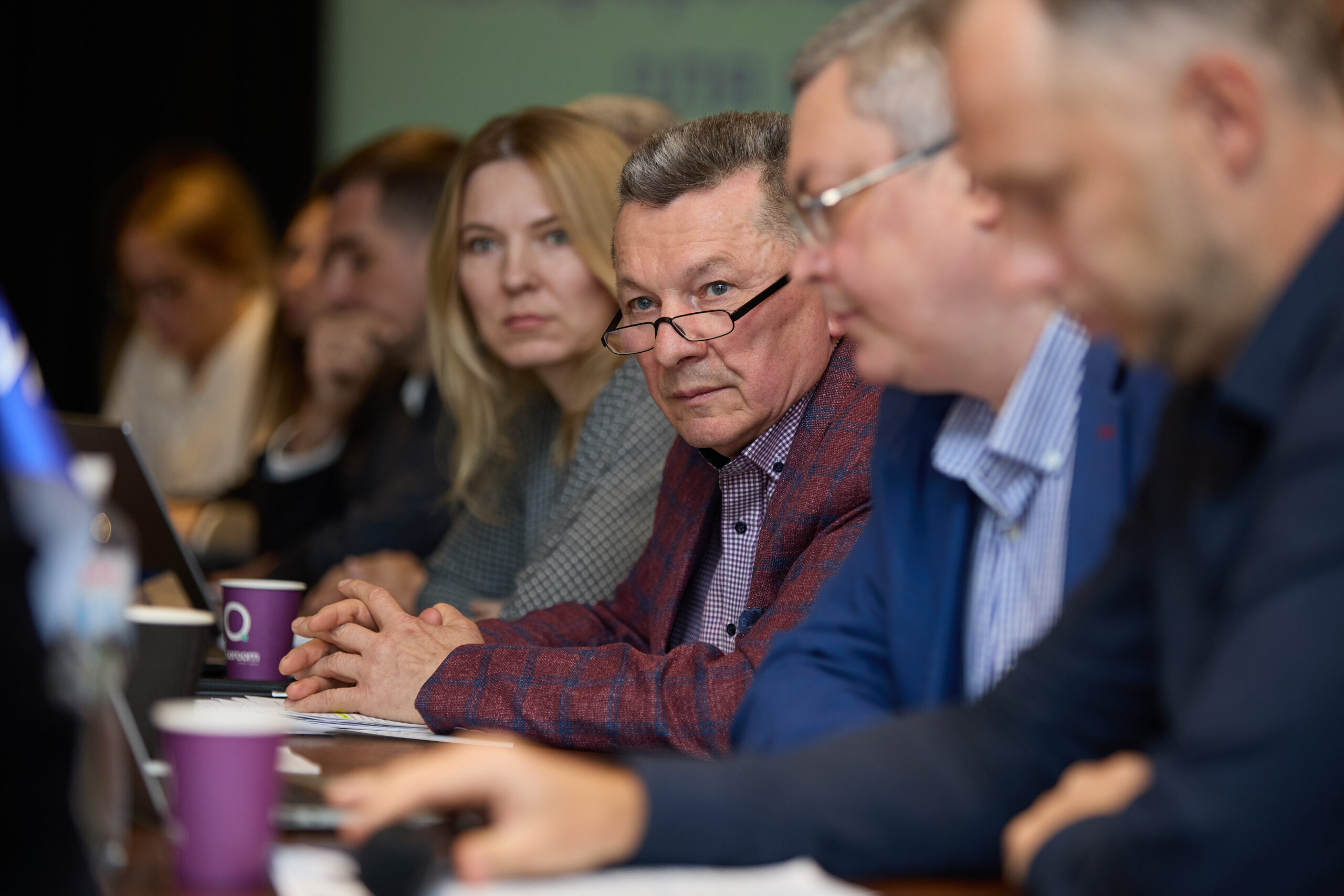
MPs and business community identify key priorities for Ukraine’s recovery
On May 9, 2025, the conference “Key Priorities 2025 for Economic Recovery” was held in Kyiv with the participation of representatives of the Parliament, business and the public. The event was organized by the Ukrainian Business Council, the European Business Association and the American Chamber of Commerce.
The legislative side was represented by: Dmytro Razumkov, Chairman of the Verkhovna Rada of Ukraine in 2019-2021, Member of Parliament and leader of the “Smart Policy” parliamentary association; Andriy Nikolayenko, Member of Parliament, Member of the Verkhovna Rada Committee on Finance, Taxation and Customs Policy; and Valeriy Bozhyk, Member of Parliament, Deputy Chairman of the Verkhovna Rada Committee on Legal Policy.
Among the business representatives: Mykhailo Nepran, First Vice President of the Ukrainian Chamber of Commerce and Industry; Borys Emeldesh, President of the All-Ukrainian Professional Association of Entrepreneurs; Khrystyna Venhryniak, Director of the Software Ukraine Association; Yuriy Perohanych, Director of the Association of Information Technology Enterprises of Ukraine; Yosyp Buchynskyi, Vice President of the Association of Taxpayers of Ukraine; Oksana Zguryeva, Head of the Business Help NGO; Yevhen Riyako, Ukrainian Bar Association, and others.
Mykhailo Nepran started the discussion with a strategic vision of Ukraine’s recovery, emphasizing the need to define the model of the economy after the war. He emphasized that it is important not just to talk about “a prosperous and powerful Ukraine” but to clearly define the areas that will become the drivers of the economy. Nepran expressed concern about the defined role of Ukraine as a raw material appendage and asked for the position of the Smart Policy on the vision of Ukraine and on the ratified agreement, which could be the beginning of a new industrialization.
In response, Dmytro Razumkov emphasized the importance of restoring Ukrainian business as a matter of priority to secure funds for further reconstruction. He also mentioned his proposal to allocate part of the international aid to concessional lending to businesses in the liberated territories. Razumkov expressed concern about the prospect of Ukraine becoming a “raw material center of Europe” and emphasized the need to develop processing in Ukraine.

The politician identified five basic conditions for the return of people: a roof over their heads, jobs, schools, hospitals and shops. He singled out the defense industry as one of the most promising sectors, emphasizing the need to allow the export of Ukrainian drones.
Andriy Nikolayenko supported the idea of developing a post-industrial economy, noting:
“Ukraine has every reason to be a post-industrial state because we have a highly intelligent nation.”
He emphasized the need to revive heavy industry and metallurgy for recovery, citing the specific example of flat glass production in Ukraine. Nikolayenko also emphasized the need for tax reform aimed at reducing rather than raising taxes and expressed support for the creation of a financial center in Ukraine, following the example of Astana. He criticized the National Bank’s current policy of tying up a large amount of money supply and recognized the failure of the currency and inflation targeting policies.
Mykhailo Nepran noted that there is no need to rely on light industry as a driver of the economy, recalling the unsuccessful experience of Yevhen Marchuk’s premiership. The First Vice President of the CCI supported the idea of developing highly intellectual industries with high added value.


Regarding the reboot of the State Tax Service, Dmytro Razumkov presented an alternative draft law from the Smart Policy party, which proposes to involve international representatives at the initial stage and then transfer control functions to business representatives.
Andriy Nikolayenko emphasized the importance of abandoning “fee plans” in favor of a system of forecasting and expectations. He also proposed to combine the functions of the Ministry of Economy and the Ministry of Finance, comparing the current situation with the appointment of an accountant as head of a manufacturing company.

In response, Dmytro Razumkov proposed to support the draft law No. 8387 on the presumption of business’s rightness when blocking tax invoices, according to which the tax authorities, not the entrepreneur, should prove the fact of violation, blocking should be temporary, and tax authorities should be held liable for unlawful blocking.
Oksana Zguryeva emphasized the lack of dialog with the Ministry of Finance and the tax service:
“For many years, we, as an expert council, have been involved in discussions with the Ministry of Finance and the Tax Service on the conditions under which tax invoices are suspended and registered. We managed to change and mitigate a lot of things. But over the past year, all this has been going on behind closed doors, without the involvement of independent experts.”
Natalia Artemchuk, representative of the European Business Association, expressed concern about the draft laws on KPIs for tax and customs, emphasizing that these documents shift the responsibility for determining the indicators to the Ministry of Finance. The Ministry of Finance will once again propose the indicator of the budget revenues plan fulfillment as the main indicator and no changes will be made in the work of the tax and customs authorities. She also asked about the ideas of a possible increase in the VAT rate and the introduction of a progressive personal income tax scale as recommended by the IMF.
Andriy Nikolayenko confirmed the discussion of a progressive taxation scale, but expressed doubts about its feasibility in the current environment.
Oksana Zgurieva presented a study on the criteria for distinguishing freelancers from employees, which analyzed the experience of different countries. The researchers came to the conclusion that 9 criteria should be legislated, and if 7 of them coincide simultaneously, the relationship can be considered labor. Oksana emphasized the need to leave the final determination of the status of the relationship to the judiciary, not the executive branch. MPs expressed their readiness to work on the relevant legislation.

Yosyp Buchynskyi presented proposals to the draft law No. 12439 on business protection during criminal proceedings. He emphasized the current disenfranchised status of third parties during the investigation and proposed to grant them the status of a party to criminal proceedings, as well as to define the status of “temporarily seized property” for everything seized during a search and to strengthen the rights of suspects in the appointment of forensic examinations.

Valeriy Bozhyk supported these proposals, agreeing with the problem of law enforcement pressure on business:
“Right now, law enforcement officers are taking advantage of the fact that we have a lot of restrictions on business, and they are given a lot of rights, so they are using this in their own interests.”
The MP proposed to establish clear requirements for the technical support of video recording of searches, to develop sanctions for non-compliance with decisions to return property, and to introduce effective preliminary control over the validity of searches.
Yevgeniy Riyako added to the discussion the problem of exorbitant unreasonable bail amounts for entrepreneurs:
“In every unclear situation: “Give me a bail that exceeds the maximum amount of 900 thousand – give me 900 million”. In my practice, one out of four bail bonds was over a billion hryvnias. And why not? It’s a good number – it sounds great.”
He proposed an alternative mechanism: the court would first set a standard bail, and only in case of violation would a higher amount be applied. Regarding searches, Riyako proposed to introduce a system where a search warrant is issued by three judges with automatic distribution throughout Ukraine, which would make it impossible to abuse “pocket” courts.
Yefrem Lashchuk, Legal Policy Specialist at the Economic Expert Platform, spoke on the taxation of goods coming through foreign marketplaces, pointing out the expected budget losses due to VAT benefits for parcels worth up to 150 euros in the amount of 17 billion hryvnias in 2025. He presented draft laws No. 12429 and No. 12430, which introduce the “One Stop Shop” model, where VAT is paid directly by the marketplace.

Alexander Yavorsky, a representative of the American Chamber of Commerce, supported this initiative, emphasizing its importance for creating jobs in Ukraine. He noted that the European Union has already introduced taxation of all goods in parcels starting in 2021.
Yuriy Perohanych emphasized the problem of unequal competitive conditions for Ukrainian and imported goods:
“If there is a difference of 20 percent VAT between imported and domestic goods, then no matter what dam you build at customs, it will still be eroded.”
He noted that the association estimates that only 10 percent of parcels come from relatives abroad, which refutes the argument about the social component of these benefits.

In response, Andriy Nikolayenko emphasized the increase in parcels from relatives after the full-scale invasion. He supported the idea of taxation at the marketplace level, but expressed concern about the creation of new tax evasion schemes.
Dmytro Razumkov assured that Smart Policy would not vote for a VAT increase, but MPs are ready to raise taxation at the marketplace level. It is necessary to work out the optimal version of the draft laws so that VAT is collected by marketplaces and does not complicate anything for Ukrainian consumers.
During the discussion on prices, Iryna Ogorodnikova, a specialist at Crowe Mikhailenko, noted that Ukrainian goods lose out due to the lack of an effective national cashback system, while imported goods receive a refund through banking programs, creating a difference in price of about 18%.
Dmytro Razumkov criticized the idea of national cashback, calling it a tool for collecting information about citizens.
Khrystyna Venhryniak suggested developing public-private partnerships in creating electronic services following the example of Estonia. She emphasized that today Ukrainian IT exports are mostly “raw materials” and it is necessary to stimulate the development of value-added products. Khrystyna mentioned the X-Road system purchased by Ukraine from Estonia to exchange information between registries and suggested allowing private companies in Ukraine to create electronic services based on government data.

The MPs expressed conceptual support for the draft law No. 7508 on public-private partnerships, although Andriy Nikolayenko noted the limitations of private companies administering state registers.
Yulia Zhytinska, representative of the All-Ukrainian Association of Passenger Transportation, highlighted the issue of privileged transportation, noting that the number of such clients is growing, including military personnel and people with disabilities, and carriers cannot afford to serve everyone at their own expense. She proposed to keep the privileges, but later move to providing monetary compensation by the state directly to the beneficiaries, and asked to support the relevant draft law No. 5651-2.
Dmytro Razumkov confirmed his support for this initiative.
Following the conference, the participants agreed to further cooperate on priorities important for the country’s economy, including rebooting the tax service, developing labor criteria, protecting business in criminal proceedings, leveling competition and developing public-private partnerships.
Dmytro Razumkov thanked the participants for the constructive dialog:
“I thank you for today’s honest conversation. It is our joint work that will bring important decisions for economic recovery.”

