


SMEs should be there. Business associations name “lost” points of the SME Recovery and Development Strategy
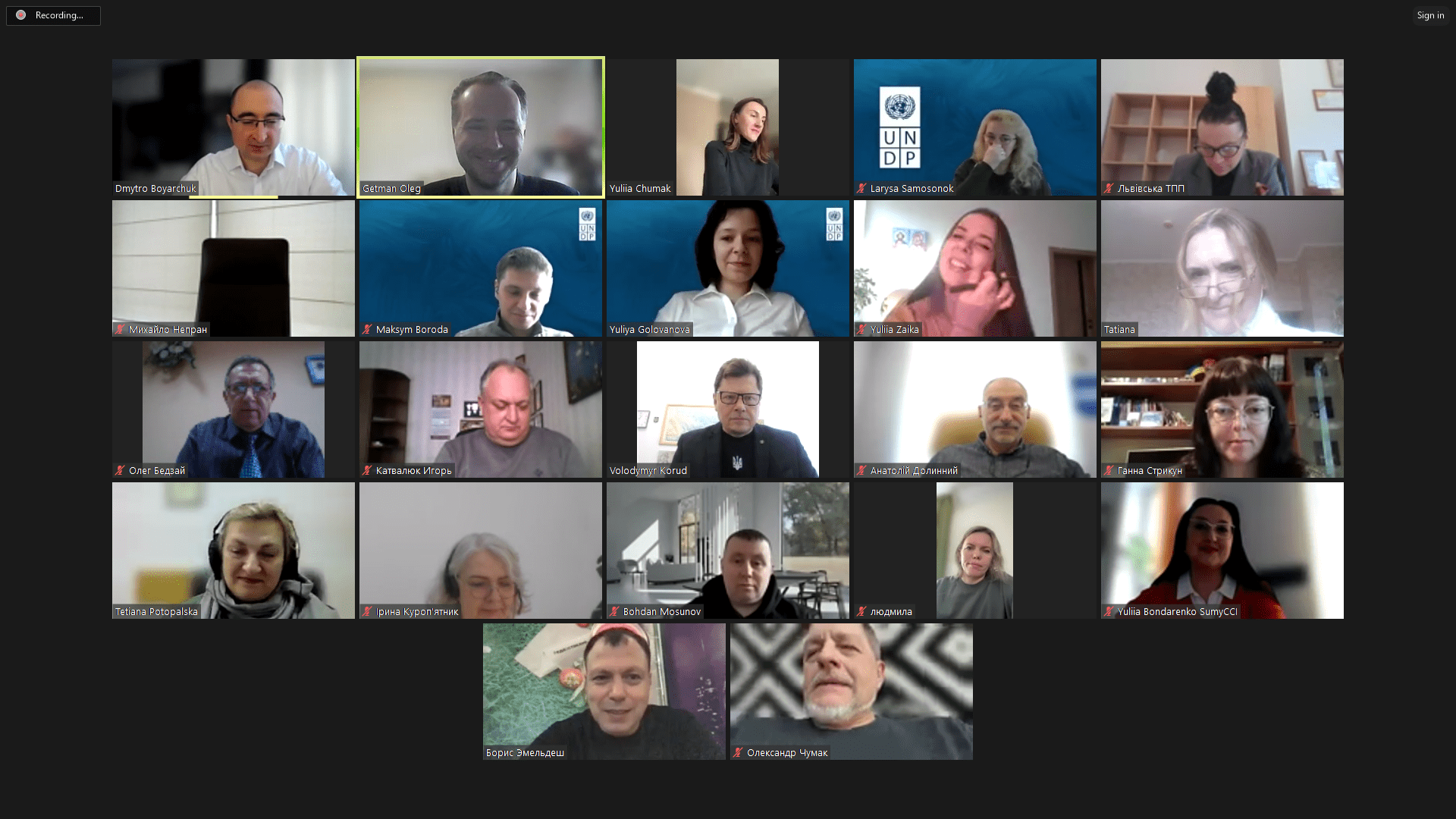
On March 15, the Ukrainian Business Council, which unites 114 business associations from various sectors of the economy, with the support of the United Nations Development Program (UNDP) in Ukraine, held an online meeting to develop proposals from businesses to the government’s draft Strategy for the Recovery, Sustainable Development and Digital Transformation of Small and Medium-Sized Enterprises until 2027.
The discussion of the SME Development Strategy for the next three years was attended by 70 representatives of MSME member business associations and Ukrainian think tanks.
Addressing the participants, Maksym Boroda, UNDP Ukraine Project Manager of the Strengthening of Member Business Associations and MSMEs in Ukraine Project, noted that the government’s draft Strategy needs to be finalized, taking into account the interests of the business community, so that “the final version of the Strategy will be much better than the draft we have.”
Before the discussion began, Dmytro Boyarchuk, Senior Economist and Head of CASE Ukraine, presented the results of a survey of the meeting participants.
In particular, when asked “What hinders business development?”, the majority (over 70%) mentioned the lack of labor force and almost half (47.8%) pointed to the decline in consumer demand due to the war. Next is excessive bureaucracy in the interaction between business and the state (44.9%).
“The war has played a role in the problems for business, but what happened before the war remains relevant,” Boyarchuk summarized.
Regarding the key reforms needed for the development and recovery of SMEs and what is important to add to the Strategy, the majority (63.8%) said that the simplified taxation system should be preserved and that total fiscalization of groups 2 and 3 should be replaced by fiscalization exclusively for certain risky groups of taxpayers who have significant risks of exceeding the limits.

Speaking about the draft Strategy, Oleh Hetman, Coordinator of Expert Groups at the Economic Expert Platform, highlighted its main points, advantages, and disadvantages.
“The Strategy is a very massive document with more than 100 pages. Most of the document says that everything should be digitalized, deregulated, and trained, but there are very few points that would solve the biggest problems of SMEs, according to surveys of SMEs. Therefore, it is worth communicating with the Ministry of Economy and adding those important points that are most relevant for SMEs now,” said Oleg Getman.
According to him, the document lacks a large block on inclusive dialogue between the government, business and civil society, as well as simplification of tax administration, abolition of mandatory acts of work performed, return of the presumption of innocence to the taxpayer, institutional reforms (reboot of the BES, tax, customs), reduction of the total burden, simplification of cash registers as a problem for small and microbusinesses; creation of a hotline for quick response to business requests.
“This is what we have seen from various business surveys and what think tanks and the Economic Expert Platform believe is missing in this Strategy,” said Hetman.

Oleksandr Chumak, President of the Association of Private Employers, member of the BOC: “The main drawback of the Strategy is the government’s complete lack of vision of business associations as partners and the main network for entrepreneurship development in the country, which should formulate and implement the state strategy for entrepreneurship development. That is, we are not there at all. On the other hand, for some reason, the Cabinet of Ministers and the Ministry of Economy ask us to make proposals to this Strategy. Therefore, a separate large block of this Strategy should concern business associations as organizations that work together with the government at all levels – from regional to local local governments and promote entrepreneurship. We should be there.”

Borys Emeldesh, President of the All-Ukrainian Professional Association of Entrepreneurs, member of the URB: “When we are setting priorities, we should not forget that the main task of fighting for small business is to preserve the simplified system. In my opinion, this is a crucial task, no less important than institutional reforms and so on.”
Among other things, the participants propose: to shorten the Strategy from 100 to 5 pages (and to include everything else in the Strategy Implementation Program); to consider the quality of the use of donor international assistance; to create special incentive programs for youth entrepreneurship; to develop exports, including through the CCI system and business associations; to defiscalize the self-employed; to create additional opportunities for the development of women’s entrepreneurship, to introduce a special regime for the self-employed, to liberalize market surveillance, etc.
The meeting will result in joint proposals from business associations to the Strategy for Recovery, Sustainable Development and Digital Transformation of Small and Medium Enterprises until 2027, which will be presented on March 18, 2024, during a meeting with representatives of the Government and Parliament.

